The Queen’s visit to the Western Suburbs

Mosman Park Primary School Children waiting for the Royal Visitors 1954
Copyright The Grove: No100149

On the 26th March 1954 at 5.30 pm the Queen and the Duke of Edinburgh landed at Perth Airport, after flying in from Kalgoorlie, for the final leg of their Australian tour. At 27 years old, the Queen was the first and only reigning monarch to have personally visited Australia. The Australian tour began a month earlier on the 3rd February 1954 when the Queen and Duke sailed into Farm Cove, Sydney in New South Wales at around 8.30am. The Queen was to visit every state and territory culminating in Western Australia. During her time in Western Australia, the Queen would visit Government house, undertake other royal engagements around Perth and travel through the western suburbs.

Coinciding with the Queen’s visit to Western Australia was a major outbreak of polio. This was a disease feared by many before an effective vaccine was developed. It was decided in consultation with the Queen to revise plans for the Queen’s visit to WA for her own personal safety. Measures included the elimination of any hand shaking, all onshore meals for the queen were to be prepared and taken ashore from the royal yacht Gothic and the Gothic was to be the Queen and Duke’s residence for their time in Western Australia, rather than Government House as originally intended. The Gothic was berthed at Fremantle at Victoria Quay between B and C sheds. The prime minister of the time, Robert Menzies, remarked that, “Residence on the Gothic, with added travel to and from the ship, would give the general public more opportunity to see the royal visitors.” Thousands of children and adults lined the routes along Stirling Highway or Canning Highway as the Queen and Duke left the ship each day on their tour of Perth and its environs. It was reported in the Western Mail newspaper that on the afternoon of March 29th, the Queen was welcomed by the biggest crowd ever seen in WA and that at Leighton, bathers left the sea, and joined in the cheering and flag waving crowd on the roadside.

Because of the polio outbreak, a children’s review at the Claremont Showgrounds was cancelled and instead the Queen and the Duke of Edinburgh were to travel along two additional special routes for the benefit of the children. The different school groups would be segregated at each strongpoint along the route. At these strongpoints, the Queen’s motor vehicle would travel at a slow walking pace for the crowds to be able to get a good view of the monarch. The general public were not permitted to stand in areas designated for school children. It was estimated in newspapers that 13,000 children would line the route on the final day. Among them would be children from Cottesloe, Peppermint Grove and Mosman Park.

Copyright The Grove: The Queen Perth 1954  
Mosman Park Review April 1954           
Copyright The Grove: The Duke of Edinburgh Perth 1954
Mosman Park Review April 1954

Copyright The Grove: The Queen Perth 1954
Mosman Park Review April 1954

The queen wowed the public with two or three different designer outfits daily. Here she is seen on her final day in Perth (see adjacent photo). The queen was described as wearing a canary yellow dress with matching hat. Her gloves, handbag and shoes were white. She wore a mink cape around her shoulders.

The queen’s final day in Australia was on 1st April 1954. She travelled from Government House to Fremantle through the Western Suburbs before finally being farewelled at Fremantle. The Queen’s tour of the western suburbs was the largest progress through the metropolitan area. The Queen and Duke travelled to Kings Park and through the suburbs of Nedlands, Dalkeith, Claremont, Cottesloe, Peppermint Grove, Mosman Park and North Fremantle before finally arriving at Fremantle Oval for a last civic reception of the tour.

The newspapers carried maps of the Queen’s routes together with estimated times she would be expected to pass by. The population of Western Australia did not disappoint and over 150,000 people lined the route to catch a glimpse of the Queen. Along Stirling Highway from Burt Street to Forrest Street waited children from Cottesloe North Primary School and Presbyterian Ladies College, From Jarrad Street to Irvine St were children from Cottesloe Primary and Cottesloe Infants Schools and along Stirling Highway from Willis Street to Glyde Street were children and adults from St Hilda’s, Mosman Park Primary School and Iona. The Queen and Duke travelled in an open top car as seen in the photo below.

The Queen and Duke travelling along Stirling Highway, Mosman Park 1954
Copyright The Grove: Mosman Park Review April 1954

On the 58th day of the Queen’s official Australian tour and her final day in Western Australia, the Queen was finally farewelled from Fremantle docks by large crowds including the Governor General Sir William Slim, Prime Minister Robert Menzies, WA Premier Albert Hawke (Uncle of future Prime Minister Bob Hawke) and other officials. As the Gothic sailed out of Fremantle harbour, she was given a 21-gun salute and an RAAF escort overhead. Thousands of boats lined the harbour including pleasure cruisers, dinghies, and cray fishing boats from as far as Lancelin and the Abrolhos Islands. The next official destination on the Royal tour was Sri Lanka and as the Gothic sailed out of Fremantle sirens echoed around the harbour to which the Gothic replied. The Queen and Duke had captured the hearts of many on their visit to Western Australia who enthusiastically showed their appreciation. The western suburbs were no exception. The royal visit was fondly remembered by those in the crowds for years to come.

Russell Brown

Russell Brown was born on 7 May 1947 in Devonleigh Hospital, Cottesloe. Russell had three younger sisters: Leonie, Maureen and Helen. His father was Alfred Benjamin Brown (known as Ben) and his mother was Dorothy (née Eboral). The Brown family have a long history of involvement in Mosman Park. Russell’s grandparents Alfred Billsom Brown and Ethel Theresa Brown came to Perth from the goldfields in 1911. They accumulated many properties in the area and built the family home on 2 Stuart Street, Mosman Park in 1913. Russell’s parents moved into 2 Stuart Street in 1946 following their marriage. Russell was to live there until 1971.

Russell described 2 Stuart Street as his grandmother’s dream home. The house was originally brick and iron with leadlight windows and a turned wooden posted veranda until Russell’s father ‘’modernized’ the veranda in the 1960’s. Russell’s grandfather Alfred nicknamed ‘Secondhand Brown’ or ‘Khaki Brown purchased 7 Glyde Street and kept many of his old war purchases in a shed in the yard at 9 Glyde Street which was then a vacant paddock. Among his many purchases were five tea chests of army socks, battle jackets, tin helmets and two sea mines. Russell recalls, ‘’I was a pretty popular kid in Mosmans because we used to play wars and we all had a battle jacket and a tin hat each…Every flue pipe or chimney had a tin hat on it around that little area of mozzies because they didn’t burn out…the kids used to come and play after school.””

Russell remembers on Sunday nights the Brown family used to gather at 7 Glyde Street after dinner and socialize. They would play the piano, cards or chat. The children would often get bored, and Russell recalls they would go to Jefferies shop for an ice-cream. He said, “’Then we used to go and stick the ice-cream cone on Mrs Lancaster’s shop window… no wonder she was a bit shirty with us.”  In those days Glyde Street was a busy place. Russell remembers “When I was a kid Glyde Street was full of people. Saturday morning you couldn’t move in Glyde Street. It would be four deep on the footpath… people shopping.” There were many shops including a butcher’s shop, a greengrocers, a barbers, a delicatessen and a drapery shop. Russell recalls ”People knew everyone then. You didn’t just go to a place or space like Coles or Woollies and do your shopping, you went to Frank Duff the butcher and bought your meat.”

Stuart Street in the 1950’s and 1960’s felt like a real community. Russell said, “’ Everyone had a chook pen, and you knew all the kids…” There were mostly residential properties with a few shops. Among his friends was Jim Dowding and his brothers. Jim introduced Russell to the Scouts, which he joined in 1955. The scouts became Russell’s first real involvement in community interests which was to last a lifetime. A new scout hut needed to be built and paid for and involved a substantial amount of fund raising. Russell said, “’Behind the Scouts Hall between Palmerston Street, McCabe Street and Wellington Street was an open area on the side of Monument Hill where they used to do the Harley Scramble every April or May every year… It was noise and smoke and dust and so exciting.” The Scouts and the parents committee used to rope off an area and charge people for parking. This enterprise partly payed for the Scout hut.

Harley Scramble looking South West on the course
Copyright The Grove: No 100171

Russell was educated at Cottesloe Primary School and Hollywood High School. He remembers a few of his teachers at Cottesloe including Bill Love who he later did some plumbing work for and Ernie Charlton the headmaster who Russell described as “…a little bald-headed bloke. Everyone was terrified of him.” Russell enjoyed school but his future had already been decided by his father. Like him, he was going to enter the plumbing business. Russell remembers Eddy Rhodes a friend of his father saying, “You want to be better than your dad.” Russell said that became his goal in life, to be like his dad but better. He joined his father’s business in 1962 on a five-year apprenticeship which he completed in 1967.

The business operated mostly around Mosman Park and North Fremantle although did stretch as far as Subiaco and Cannington Bridge. Russell knew many residents by name. He said, “I always tell people I have been in every house in Mosman Park, it might be an exaggeration…” His early work involved digging out large amounts of early galvanized piping and replacing it with copper. Russell remembers there were also some interesting call outs. He remembers going to clear the gutters for a man called Frank Caine on Fairlight Street. Frank only had one arm. Russell remembers just putting the ladder away after clearing the gutters when Frank appears on the veranda of the house next door. Russell had gone to the wrong house. He also remembers a late night call out to Iona College. He was just in his suit ready to go out for the night, so he and his colleague got in the van in their suits. Russell said, “There were all these girls in the boarding school screaming with laughter at us – plumbers in suits.” He had known many of his clients since he was a boy and they had remained with him when he took over the business from his father in the 1980’s. However, Russell suffered a from a back injury and had to retire from plumbing in 1991. He moved into the real estate business, working with the same customers he had known through his plumbing business.

Russell lived at 3 Stuart Street until 1971 when he purchased his first house at No 3 Gibbon Street. He said, it was an old weatherboard house typical of the style found in Mosman Park. It had a central passageway with rooms off to the side and an extension at the back with, “a step down to a small kitchen on the right and a small dining room and bathroom on the left-hand side. Toilet and laundry at the back.” Russell recalls the house was originally owned by Billy Martin, the night man in Mosman Park. Russell said, “He used to go round all the back lanes with a horse and cart and pick up all the dunny cans out the loos right at the back fence. They reckoned he used to have a big ten-gallon hat… he used to wear that around the street. When he was working, he used to pick up the dunny can, put it on top of his head and walk along to the cart and stick it onto the cart.” In 1974 Russell moved to Alfred Cove where he was to live for the rest of his life. However, he said, ‘I still think of Mosman Park as my home, even though I’ve lived in other suburbs (and I do now). I like living in East Fremantle, but I just feel at home when I’m in Mossies. It’s a connection that’s hard to break. Anyone you talk to that’s lived there, they think they belong there, they think they own it’

Russell was introduced to the Mosman Park Rotary Club by a builder friend Merv Ward. Russell said, “When I got there, I knew everyone.” During his many years at Rotary, Russell held many positions including Bulletin Editor, Vocational Director, Service Director, Community Services Director and Sergeant at Arms. He also held the honorary position of President for two terms, from 1990-1991 and from 2003-2004. Russell said he found being president easy and enjoyable. Russell also volunteered for the RSL Mosman Park sub-branch as secretary.

Russell’s work and commitment to Mosman Park was lifelong and in 2011 his voluntary efforts were acknowledged and celebrated when he was awarded Mosman Park Citizen of the Year in 2011. Sadly, Russell passed away in 2013 but in recognition of his contribution to the town and as a tribute to him the new adventure playground off Downey Drive was named in honour of him: The Russell Brown Adventure Park.

Russell Brown Memorial Plaque

Alfred Benjamin (Ben) Brown

No 101160 Salvation Army Citadel, Glyde Street, Mosman Park
Copyright The Grove

Alfred Benjamin Brown (known as Ben) was born on 4 September 1923 at Nurse Loveland’s hospital at 19 Perth Street in Cottesloe. Ben had three older siblings: a sister Pat, and two brothers Fred and Lindsay. Ben’s father was Alfred Billsom Brown, a boot maker. Ben described him as “a big bloke, six foot two and weighed about seventeen stone.” His mother was Ethel Theresa Brown (nee Curwood). Ben described his mother as lovely.  She was the daughter of Ben Curwood, who was a mining engineer working on the Sons of Westralia Goldmine at Morgans. His parents moved down to Perth from the Morgan’s Goldfields in 1911. They built the family home at 2 Stuart Street, Mosman Park in 1913. The block of land and the house cost £350. The builder was Ted Fieldgate from Mosman Park. Ben spent the next 65 years living in Mosman Park.

Ben lived at 2 Stuart Street until 1934. Alfred by then had purchased a block of land and the house behind at 7 Glyde Street (it had originally belonged to Webb and Co. photographers). This house was larger. The Stuart Street house was let out from 1934 to 1946. When Ben returned from the war and married his wife Dorothy (née Eboral) in 1946, they moved into 2 Stuart Street on a Peppercorn rental and lived there for forty years. Ben eventually inherited the house from his mother and bought out his other sibling’s shares. The house finally became his.

Ben said he was ‘a bit of a ratbag as a kid’. Ben remembers when he was about ten or twelve years of age he and his friends would run up and down the streets at night and throw bricks onto the roofs of buildings. They would worry the shopkeepers, especially Mrs Lancaster, whose haberdashery shop was on the opposite side of the street. They would regularly open and slam the shop door. Ben recalls they also had hill trolleys. and would go up and down Glyde Street annoying everyone. There was a Salvation Army Citadel a couple of vacant blocks down from Ben’s Glyde Street house. The service would start about eight o’clock in the morning and they would start to throw bricks onto the roof. Ben said, ‘a bloke would come out and go crook and say we should be in there listening to things.” The family never went to church and Ben said he has never believed in religion.

Ben attended Cottesloe Primary School from the age of five. He remembers some of his teachers. He said Mrs Green was a lovely lady and when he was in the plumbing business, she would ring up and say, “Send Benny up to do some plumbing for me.” She lived in Mann Street in Cottesloe. Ben remembers Bill Love was a good bloke too. Mr Cole was the headmaster; he was in charge of the pre-primary school. Ben recalls he was also a nice bloke and he lived in the house adjacent to the pre-primary school. Ben remembered doing some plumbing work for Mr Cole. During his school years Ben received the cane several times as punishment for fighting as well as having to frequently fill the woodshed. Ben recalls he and Harold (Wright) …” never saw eye to eye. We used to have a fight every night or every second night … I would give him a belting and the next night he would give me a belting it went on and on and on… they used to deliver wood for the wood fires in the school. Every time there was a load of wood Harold Wright and Ben Brown used to have to chuck it into the woodshed.” Ben later attended Fremantle Boys School where he also received the cane on several occasions but recalls that it was a good school, and he gained his junior certificate.

From a young age Ben was involved in entrepreneurial activities. As a boy he used to work for Jeffreys the Greengrocers, making deliveries on his pushbike. He used to save his pay and when he was around fourteen or fifteen, he purchased a Ford T truck. His brothers had bought a car wrecking business by this time. Lindsay found a buyer for the truck and Ben sold the Ford T for a profit. Ben was to buy and sell many more.

When he finished school a friend of Lindsay’s worked as a plumber for Ernie Sherwood and helped Ben obtain an apprenticeship there. Ben described Ernie as a good bloke who eventually took a liking to Ben. When he was sixteen years old Ernie would tell him to take the truck home at weekends to clean. Ben would use it for personal use driving his friends and girls around town.  As an apprentice, Ben would dig drains and put in water pipes. Ben’s apprenticeship was interrupted by war service. He was away for four years including twelve months stationed in Borneo. He said, “Everybody treated you different when you came back … they’d give you a bit of respect which you deserved.” Ben returned to Sherwoods to finish his apprenticeship and later left because he said, “I couldn’t be bothered with his son.” Ben didn’t like the way Sherwood’s son Gus treated the apprentices including himself.

No 101873 Vivian’s Licensed Plumbers, Cottesloe
Copyright The Grove

Ben went to work for Bill Vivian, whose premises were on the corner of Jarrad Street and Railway Street, Cottesloe. Ben was employed there for three years until he eventually decided to go out on his own. He recalls Bill came to him and said “Any way I can help you, let me know. I don’t mind if you pinch my customers, I’ll get other ones.”Ben said, “That’s the sort of bloke he was.”

Ben also went into the rag and bone trade. He said it was a very lucrative business collecting rags, bags, bottles and bones. He collected bottles from around Subiaco and from around the lanes of Mosman Park and Cottesloe calling out ‘Bottle-O’. Ben said, “There were mostly beer bottles around Mosman Park …there were some good boozers in Mosman Park in those days.” Ben worked with Lindsay at the Fremantle Bag Factory collecting rags to clean and recycle and he would collect the bones from the butchers shop. The bones would be made into fertilizer. All his finds would be taken back to 2 Stuart Street to be sorted.

At 2 Stuart Street the backyard was full of bones, trucks, rags and bottles. Ben had also built a Nissan Hut next to his shed where he ran his plumbing business. It had no doors or windows and was never quite finished. Dot his wife described the yard as “Rubbish!” Ben said, “…there was stuff all over the place … ‘All sorts, bits and pieces. No junk – all good stuff’.” There was no garden. Ben said ‘A bit out the front, that’s about all’. There was a shade house for Dot so she couldn’t see the rest of the yard!

Ben ever the entrepreneur also built and rented out trailers and later Cargill Caravanettes. After several years, when the canvas of the caravanettes deteriorated, Ben started to build his own with a steel roof. He made and sold more than eighteen of these from the 1960’s to 1980’s. Ben used to get the body made and Tommy Holt, a friend of Ben’s brothers, used to make up the chassis. Ben purchased the springs and axles and put them altogether. One day, Lindsay suggested he buy a welding plant even though Ben had had no previous experience in welding. Ben said, “So, I got myself a welding plant and taught myself to weld… none of them ever fell to bits!” Ben also used to build Ute bodies. He would cut the backs off cars and build Utes. He also purchased two Thames trucks; one was smashed in the back and one in the front. He cut them both in half and joined them together. Ben also used to buy trucks and vans for the business. He said he ‘always had a couple on the go’. They were profitable to sell on.

Ben also went into partnership with Johnnie Langer in a car-wrecking business. Johnnie Langer had the service station on the corner of Willis Street and Stirling Highway. Together they built a shed out the back of the service station and started wrecking cars. This was also in addition to the plumbing business. They would get rid of the car bodies and send them off to scrap metal. Ben remembers one friend of theirs, Billy Turnbull, had a Chev 4 car which had recently had two new tyres fitted. Billy had brought the car to the service station to put petrol in. but after he had filled the car with petrol it wouldn’t start. Ben offered Bill a pound for it in jest but was surprised when Bill accepted. Ben said it turned out to be the worst car they ever bought! In the end they towed the car out to the Sea View Kindergarten in Cottesloe because the kindergarten wanted a car for the children to play in. However, the Kindergarten required modifications to be made for it to be suitable for the children including welding and repainting. Ben said, “It was there for years but it cost us money.”

When Ben retired his son Russell Brown took over the family plumbing business. Ben moved to East Fremantle in his retirement years and sadly passed away on 23rd June 2011.

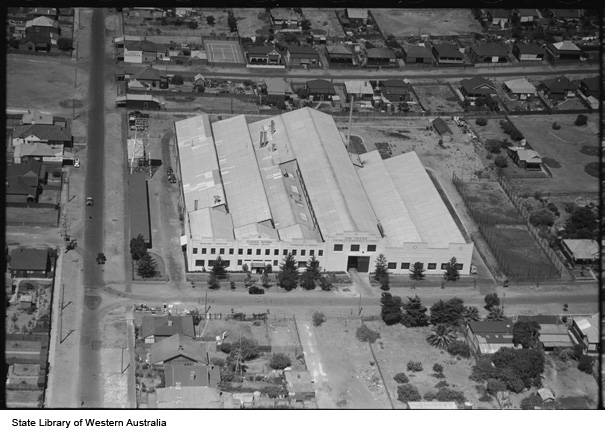
Ronald Jess and the General Motors Holden Factory Mosman Park

Copyright Trove: Gore, Stuart & HRRC 1930, General Motors assembly plant, Mosman Park

Ronald or ‘Ron’ Jess was born on 12th November 1942 in Guildford, Western Australia to parents Robert and Maude-Sarah Jess. He had four siblings; two brothers and two sisters. His father Robert served in the RAAF during the Second World War and later worked at Baird’s Department store in Perth before taking up a War Service Farm at Jerramungup. The family spent their time living in South Perth where Ron attended Kensington and Victoria Park Primary Schools. The family made regular visits down to see Robert on his farm near Bremer Bay. Following Ron’s attendance at Kent St High School, Victoria Park, he tried desperately to secure a mechanic apprenticeship. However, this proved difficult to do. He eventually found work as a motorcycle delivery driver at Coventry Motor and after three years moved on to work for Dunlop as a tyre fitter. The work was physically hard and required spending time outside in all weathers. He eagerly accepted a position with General Motors Holden (GMH) in Mosman Park which secured him better pay and conditions.

Ron worked for GMH from 1968 to 1972. He used to commute from his home in Balcatta where he lived following his marriage. Ron worked on the assembly line in the wiring section. His job was to drive the hoist which lifted the car body onto a stand so that other members of the team could work on it. He said, “’Once you were the hoist driver nobody else wanted the job. They thought it was too dangerous.” No safety clothes were provided to employees but safety glasses were provided in case of eye injuries. Ron once had a small piece of metal caught in his eye. There were posters on the wall of the factory advertising issues such as ‘Walk don’t run’ but Ron said, “Worksafe of today would pick the old GMH to pieces. No doubt they were aware of this too. It was definitely out of date.’’ However, Ron believed the efficiency was still there. He said, “For the factory as old as it was and cramped and cluttered up as it was, to get up to sixty cars assembled in one day, that was really moving, that was a great feat.’’The factory assembled both cars and trucks including Bedford trucks and various models of Holden cars. The hours of work were 7.30 am to 4pm, with a half hour for lunch, and additional tea breaks of five to ten minutes duration. Arthur Kingdom used to bring around the tea trolley with tea and sugar for those who wanted them. Ron described Arthur as a quiet, nice, well-mannered man who also ran the lunchroom. Deductions for the tea would appear on the employees weekly pay slip as shown in the photo below:

Copyright The Grove: No 101385 Ron’s General Motors Holden Weekly Pay Slip 15th June 1968

The factory was a big art deco building which was situated on the corner of Victoria St and Buckland Avenue. There were signs on the building advertising Chevrolet, Vauxhall, Pontiac and Cadillac. The factory opened in 1926 and was very noisy. There was the combination of the collective working of the assembly machinery and the constant firing of airguns and movement of forklift trucks. There was also the constant noise of hammering and the hot riveting machine. Ron remembers, “They’d put a hot rivet in and rattle it flat. That was really noisy.” The factory was hot in summer and cold in winter. Whatever the air temperature was outside that was what it was inside. The employees had to keep working regardless.

The workforce comprised of approximately eighty percent of people from the Mosman Park and Cottesloe area. Ron remembers there were a few Italians and Greeks, one Polish man and a few Slovakians. Relationships between the workers was generally good, and there was no language barrier. Ron remembers some of the team members who he used to work with. There was Ken Draper who was an ex-farmer and Doug Ladyman an ex-RAAF man. Eric Hoffman, a short Indian man whose job it was to work under the steering wheel and follow underneath the car along the assembly line. Frank O’Brien, who is the man sat in the car in the photo below, was a foreman as was Neil Wiltshire. Ron Tester, who was known as ‘blue’ because of his red hair, used to drive the forklift truck and bring supplies to the team. Jack Polkinghorn and Ron Baird worked on the line assembling engines. Harry Coyne was a leading hand in truck assembly. Harry Evans was an inspector and Don Anthony and Ron Cahill worked in the Rectifications and Quality Control Department. Rectifications were carried out on vehicles which went through the line with missing parts or where mistakes had occurred and needed correcting. There was a rumour the factory was going to close and in May 1972 management came around quietly to confirm the factory was going to close in three months time. Ron said, “’We didn’t like it of course, people don’t like changes. Ultimately it was for the better. I later realised that the factory was well past its use by date.’’ The factory was in a prime residential area, in suburban Perth. GMH may have had plans to buy additional land to build an updated factory; instead, they made the decision to centralise production and the doors of the factory finally closed in August 1972. Ron was 29 years old when he left GMH. He obtained his truck drivers licence and became a driver for seven years before working as a Sales Representative for Coco Cola.

Copyright The Grove: No 101388 The last Holden assembled in General Motor’s Mosman Park Factory 1972

Murder in Mosman Park

1950’s


Copyright The Grove: 103493 Mosman Park 1950’s

On the night of the 22nd of June 1959, a 21-year-old former Mosman Park resident named Robert Jeremiah Thomas went on a gun rampage through Claremont, Mosman Park and Fremantle. The gun violence would end at Fremantle cemetery where he finally gave himself up after shooting himself in the jaw. He had killed three people, attempted to murder a fourth and seriously injured a fifth. The reason why he suddenly decided to set off on this killing spree is not known but he was to become the penultimate person to hang in WA.

Thomas arrived in Perth on 20th of June 1959, after working a few months away in Trayning, 236 kilometers to the east of the city. He spent the rest of that day, and the following two days, drinking in various public houses culminating in a drunken brawl. He was hit so hard by his drinking companion Kevin Ladham that it fractured his jaw.  Intoxicated and angry he got into a taxi and went to Inglewood where he knew he could get himself a gun and some ammunition. He arranged to collect the gun at 9.45pm, in a laneway at the back of Third Avenue, in Mt Lawley. He said he was going to use it to shoot Ladham.  However, for some reason his plan changed, and when the taxi arrived at Bay View Terrace in Claremont, he shot the taxi driver dead. Pushing the body out of the car into the gutter, he drove off towards Mosman Park.


Kaye Marion O’Hara
Copyright Trove; Daily News, Perth, Thursday 25 June 1959 Pg 1

Thomas arrived at Jimbell Street and parked outside his former childhood home. Sleeping inside were a young couple and their 6-month-old baby Cindy Lee. The couple were John O’Hara and his wife Kaye Marion O’Hara. John was 21 and his wife only 17 years old. The couple were known to Thomas, but he had not seen them for some time. He callously shot them both in the head while they lay sleeping.

Thomas then drove to Wellington Street to the house of John Bruce Cooper. He arrived there about 11.40 pm. Three years ago, he had lodged with Cooper at this address when his relationship with his stepfather had broken down whilst he was living in Jimbell Street. Cooper had asked him to leave after a few months, believing him to be unclean and a bad influence on his son. He said Thomas never washed and only had a bath once every six weeks. Thomas left the lodging without incident however Cooper met with him again a few months later to tell him to stay away from his son.  This must have upset Thomas. When Thomas arrived at Cooper’s house he rang the doorbell continuously. When Cooper came to the door Thomas asked him to turn on the light. Cooper asked why and then caught sight of Thomas’s gun. He ducked as Thomas fired and quickly shut the door behind him. He then alerted police.


Taxi Driver John Donnan
Copyright Trove; The West Australian, Perth, Wednesday 24 June Pg 1

Meanwhile, Thomas got back into his stolen taxi and drove to Fremantle looking for policemen. He stopped outside the Commercial Hotel (now Sundancer backpackers in Fremantle).  It was now 11.58 pm. He saw three police officers talking nearby. He fired his gun and shot one of the officers, Sergeant Hilton, in the stomach.  Further bullets missed the other two officers as they ducked for cover. As nearby witnesses came to Sergeant Hilton’s aid, the other two officers commandeered two taxis and chased Thomas through the streets of Fremantle. A third taxi driver, Robert Donnan of Wellington St, Mosman Park, overheard the police on the radio and joined in the chase.

Thomas was finally stopped at Fremantle cemetery after more shots were exchanged. Thomas shot himself in the jaw and surrendered. Collapsing as he got out of the taxi, he was taken to Fremantle hospital for treatment. It was in the hospital, where Sergeant Hilton was also receiving treatment, that Thomas was later charged with murder and attempted murder.

He never really gave a specific reason for why he murdered his victims. He said, “I got a gun so I could put a bullet in myself… I made up my mind I would take as many people as possible with me.” Interestingly, when police searched his lodgings, they found two novels. One was entitled “Assignment to Kill” and the other called “The Noose.” Despite his comments he did not seem to shoot indiscriminately. All the people he shot – apart from Sergeant Hilton – were previously known to him.

Thomas appeared to develop strong grudges against people and the police in general. He had an unhappy childhood. He shared a close relationship with his mother, but his father died during the Second World War whilst fighting in Burma. Thomas was only five years old. His mother remarried and he hated his stepfather. His younger brother James said, “I remember him as a different person, a friendly and encouraging big brother who grew up with me through unhappy childhood days and wrote frequently to me when we were separated.”

Thomas’s brother believed Thomas’s mind had become unhinged sometime during his heavy drinking binge on June 22nd. Thomas was no stranger to drinking. He began drinking when he was 16 years old and still living with his mother and stepfather. He lost his job working as a clerk with the Department of Civil Aviation because of it. He began getting into trouble with the law and was also reckless. He had two motorcycle accidents, when he was 17 and 19 years of age. One crash was intentional and nearly fatal. Thomas deliberately crashed his motorcycle in a suicide attempt after an argument with a girlfriend. He was critically ill and fractured his skull which left a permanent depression on the left side of his head. He very nearly succeeded in killing them both.


Robert Jeremiah Thomas
Copyright Trove; Daily News, Perth, Friday 25 September 1959 Pg 1

Thomas was evaluated by more than one psychiatrist, who differed in their assessments of him. One described him as having a mental disease which made him incapable of knowing right from wrong. Thomas himself said he knew his actions were legally wrong, but he believed his killings were morally right. He said, “I think I was right to shoot them.” The psychiatrist also said for the past three years Thomas had believed he was destined for the gallows and the psychiatrist believed killing was Thomas’s way of achieving his self-destruction.  Another psychiatrist Dr Ernest Thompson believed Thomas was a psychopath, who disregarded normal social norms. Whatever the diagnosis, Dr Thompson said, “I doubt whether I have seen anybody who is so absolutely without remorse as Thomas.”

It took two trials to convict him of murder.  The first trial, which delivered a guilty verdict, was appealed against on the grounds that the judge misdirected the jury. The high court agreed to a retrial which was held on 11th of March 1960. Surprisingly the second trial was presided over by the same judge. There was very little doubt over Thomas’s guilt. The debate was over the state of his mind at the time. Was he insane? Could he be held criminally responsible for his actions? Again, the verdict was guilty. The sentence was death by hanging.

One newspaper described Western Australia as “the hanging state.” By 1960 more executions (29) had taken place in Western Australia since the time of federation than in any other state. New South Wales had the next highest number of executions at 23, but they had not held any executions since 1940. At the time of Thomas’ execution other states, such as South Australia, were commuting death sentences to prison sentences. Unfortunately, this was not the case in Western Australia. Thomas was executed at Fremantle Goal on 18th of June 1960. However, popular sentiment was turning against capital punishment. There was to be only one more execution in Western Australia, that of Eric Edgar Cooke in 1964. The death penalty was finally removed from the statute books in 1984.

Thomas was a troubled young man who had an unhappy childhood; a possible psychopath who knew killing was wrong but felt for some reason he was morally right to do so. He was a ticking time bomb on a self-destructive path to the gallows. Unluckily for him, the state in which he lived was happy to make sure this destination was realised.

CRIME IN THE SUBURBS

1920’s

Cottesloe Beach (now Mosman Park) 1920’s
No 101166 The Grove Library

On the 29th of September 1927, a doctor was called to the home of William Leonard Goodwin on Solomon Street, Cottesloe Beach (now known as Mosman Park). William had telephoned the doctor to attend to Mrs. Goodwin, who had received cuts and bruises to her head, and was unconscious. When the doctor arrived, he found Mrs. Goodwin conscious but William Goodwin dying on the floor of his home with his throat cut. What circumstances could have led to this tragic incident in this ordinary, quiet, suburban street?

The inquest into the events surrounding William’s death was held a couple of weeks later. It appears that William had been drinking and had returned home intoxicated. He became aggressively argumentative, which soon led to violence. He hit his wife and knocked her unconscious. Full of remorse, he went to the nearest payphone and called for the doctor. Meanwhile, Mrs. Goodwin slowly regained consciousness. She awoke to find her husband walking around the kitchen bleeding from a large gash to his throat. Seeing she was conscious he asked her for a sheet of paper, and then proceeded to write “Goodbye to all” before collapsing to the floor. The police arrived and William died about five minutes later. The police investigating the scene followed a trail of blood leading from the kitchen to an outhouse where a blood-stained razor was lying on a bench. It seemed Mr. Goodwin had cut his own throat.

At the inquest, his wife Alice Howard Goodwin said that William had been in a “cantankerous mood for months” and that he had threatened to kill her and to take his own life on many occasions. Isaac Edward Thompson, who had known William for fourteen years, said that he knew William had been suffering from war wounds and had been mentally unstable at times. The coroner concluded that William had cut his own throat with a razor while suffering from “mental weakness.” Although nine years had passed since the end of the first world war, it seems possible that its effects were still being felt, almost a decade later.

William Goodwin was an ex-soldier. He had been a private in the 11th battalion of the Australian army. This battalion was one of the first infantry units created in Australia for the first world war and was the first battalion to recruit in Western Australia. The infantry were soldiers who would go into combat on foot. They would experience war at its rawest. William’s battalion received brief training in Perth before undergoing more extensive training in Egypt. In April 1915, the 11th battalion took part in the invasion of Gallipoli and landed in Anzac Cove.

On the 12th of June 1915, William’s name appeared on the thirty-fifth Roll of Honour list as one of the many wounded. He would return home aboard the hospital ship Hororata on the 18th August 1915. He was described as wounded and walking when he dis-embarked from the ship at Fremantle to a hero’s welcome. The photo below shows the dis-embarked soldiers from the Hororata. William is likely to be one of them.

Back for the Dardanelles Copyright Trove; Sunday Times, Perth Sunday 22 August 1915
https://trove.nla.gov.au/newspaper/article/57793957?searchTerm=W%20L%20Goodwin

William bore the physical effects of combat and was left with only one arm. This disability may have made it more difficult for William to find work, may have caused him pain and possibly affected him psychologically.

It seems conceivable, in light of later events, that he also suffered from the emotional effects of war. Many men returning home suffered from undiagnosed PTSD (Post Traumatic Stress Disorder) or ‘shell shock’ as it was known then. Unfortunately, resources would have been limited to treating only the most severest of cases, and the prevailing view at the time was that the soldiers were viewed as ‘weak’ and received little sympathy. Soldiers experiencing PTSD suffered from a variety of symptoms including anxiety, nightmares and tremors. Heavy drinking and violence towards themselves and others was so prevalent in returned soldiers that it initiated a government enquiry into the matter in 1918. The enquiry stated that the “unstable nervous condition of many returned soldiers made them more susceptible than civilians to the effects of alcohol.” To compound the problem, many ex-soldiers drank hard spirits, as they were accustomed to being given rum rations in the trenches.

It is likely that William, like many other returned Anzacs, probably suffered the effects of the war long after the last guns were fired. Suicide amongst ex-soldiers was common, as was the domestic violence which occurred privately in many households as the men tried desperately to deal with their demons. William’s experience was echoed by many returned servicemen. His was a tragic end for an Anzac hero.

1910’s

The Western Suburbs are generally regarded as a safe and pleasant place to live but occasionally a crime is committed which unsettles the whole community. One such crime occurred in 1914 on a train leaving Cottesloe Beach Station (now Mosman Park Station). The incident was to attract state-wide and national interest.  Many of the newspapers at the time named it The Train Sensation or The Girl on the Train.

Cottesloe Beach Station
No 101328 The Grove Library

Just after midnight on the night of Wednesday January 21st, 1914 a woman by the name of Mrs Minnie Sophia Thomas was violently assaulted by an unknown assailant.

After visiting friends and seeing a show at the Melrose Theatre she travelled home from Perth on the last train to Fremantle. She was the only occupant in a first-class ladies carriage. Suddenly, as the train was leaving Cottesloe Beach Station a man entered the carriage. He jumped onto the train from the track side just as the train was pulling away from the platform.

Giving evidence in court Mrs Thomas said the man came over to her, put his hand over her mouth, and told her to shut up. During the struggle he threw her to the floor and held her down by the throat while attempting to rape her. He hit her about the head with a blunt instrument and stamped on her back. He then exited the train before it pulled into North Fremantle Station.

Mrs Thomas began to scream and was found by three men when the train arrived at North Fremantle. They had been travelling in a carriage close by but had not heard anything amiss. They testified that the carriage showed signs of a struggle with blood on the floor and on Mrs Thomas’ head and clothes. She was in a state of disarray and her head was bleeding profusely. Chocolates from her bag were scattered around the floor alongside an opal ring. Believing her life to be in danger, Mrs Thomas said she had removed her opal ring during the struggle in order to prove to her husband that she had been in the carriage should the man dispose of her body. This act of bravery was to be used against her in the trial to follow.

Mrs Thomas was immediately taken to Fremantle hospital in a semi-conscious state where she was examined and remained for several days. Later that week the weapon used to attack Mrs Thomas was found at Leighton crossing about a mile from North Fremantle station.

The police thought they had caught the assailant when they received an anonymous letter implicating a Bernard Centamel Jacobsen: a builder and carpenter who had come out from England in 1912. At the time of the attack, he was living in an iron shanty in a camp approximately 300 yards from Cottesloe Beach Station on the Perth to Fremantle Road. Previously he had lived on Mason Road in Cottesloe. Mrs Thomas recognized him from a photograph she was shown and picked him out of a police line-up. Torn trousers with suspicious stains were found at his residence and he was seen in the vicinity that evening. The baton-like ‘life-saver’ weapon used in the attack was charred. Coincidentally there had been charred items found at Jacobsen’s home which were believed to have been caused by a fire which had occurred there the previous year.

Mrs Thomas
Copyright Trove; Sunday Times, Perth Sunday 17 May 1914

https://trove.nla.gov.au/newspaper/article/57824801?searchTerm=train%20sensation

Mr Jacobsen
Copyright Trove; Sunday Times, Perth Sunday 17 May 1914

https://trove.nla.gov.au/newspaper/article/57824801?searchTerm=train%20sensation

The trial lasted five days and created “much excitement in Westralia and even in the eastern states.” Jacobsen was found not guilty and released. There was a move for him to receive compensation for his time spent in jail, with an application to the state government to pay for his passage to England and twenty-two pounds for witness fees. He became an overnight sensation. He toured the state with Mr Jules Garrison and his Roman maids, telling his version of the story. He even provided autographed photographs of himself to the crowds who came to hear him at these concerts which helped recoup money spent on his defence. Was he innocent? We will probably never know for sure. His release was certainly very popular with the public and he was cheered and carried down St Georges Terrace by jubilant supporters. DNA tests today would have delivered a more conclusive verdict. However, what is more evident is the incompetence of the judge, the misrepresentation of the case by some sections of the media and a wave of popular opinion against Mr and Mrs Thomas.

More than one newspaper was heavily critical of the judge presiding over the trial saying, “When he gets a wrong idea in his head he is apt to persist in it without regard for the weight of evidence.” His summing up of the case was not only heavily biased towards Jacobsen but implied, without evidence, Mr Thomas was the perpetrator. This seems highly improbable and there was no evidence to support this, but the damage was done. Another newspaper commented that there was an “unreasonable disposition to believe harsh things of the Thomases because Mrs Thomas went to the theatre and her husband approved with her going with another man.’’ Both behaviours seemingly unpalatable to the general public. Jacobsen was seen as a hero, unjustly accused. Mr Thomas was portrayed as a villain – a probable violent attacker. He later went to obtain a job in a country town but the reception was so hostile when his identity became known that he had to return to Perth. He finally joined the army. In 1915 he and his wife returned to England to fight in the war raging in Europe.

As for Mrs Thomas there were reports in newspapers at the time disputing her story, implying it was unbelievable and fanciful despite the physical evidence to the contrary. The police certainly took the allegations seriously. However, a newspaper at the time wrote an article about the difficulties of being a lone man on a train as he could be the object of a woman’s “active imagination and hysteria” or be blackmailed for responding to “womanly wiles.” Judge Rooth alluded to this in his summing up.  When it is a woman’s word against a man’s, he said, “it was an easy matter for a woman to make charges against a man and it was extremely hard for a man to rebut them.” Regarding the opal ring, the judge said it was for the jury (all men) to believe Mrs Thomas or to “draw inference as men of the world (author’s italics) that the ring had probably been given to her by a man and she had then thrown it away before her husband could see it.” This was clearly misleading and had no basis in fact. The Crown Prosecutor responded by saying Mrs Thomas had testified that she had been given the ring by a female friend and openly named who this friend was.

Mr and Mrs Thomas were harshly treated by the judge and some sections of the media. Public opinion was heavily against them and their lives were never the same again. The assailant was never prosecuted.

By Nicola Gourlay – Community History volunteer researcher.

MOSMAN PARK UGLY MEN’S ASSOCIATION

Who were the Ugly Men?

The Ugly Men’s Voluntary Workers’ Association was a uniquely Western Australian organisation that aimed to raise money to alleviate community suffering caused by World War I.

1917 adThe problems addressed by the Association included the welfare of soldiers and their dependants, newly arrived immigrants and the development of the state’s rural industries, through the operation of a boys’ farm school at Bundidup. The Ugly Men were instrumental in activities such as building houses for the dependents of those killed in the war, assisting widows to open businesses, supplying clothing and food, and providing funds to hospitals. The money for these ventures came from fundraising activities, and free labour offered by their members, who were mostly working class tradesmen.

The association formed in 1917.  At its peak in the 1920s, the Ugly Men raised £12,000 annually for 7,000 applicants for relief.

The Ugly Men became known for their inventive ways to raise funds, including fetes, gala days, picnics, contests and carnivals. ‘Ugly Man’ competitions were popular events across the city, as seen by this 1917 advertisement in The Daily News. Nominations and voting required a coin donation.

A typical newspaper report about the Ugly Men’s Association and their activities would read like this one from 1920:

The usual fortnightly meeting of the Ugly Men’s Association was held on Monday night, when the following members of the executive were present:-Messrs. Clydesdale (chair), Barrett, Hodge, Levy, Newman, Norton, O’Connor, Jacobson, and Rhodes. The following branches were also represented by their delegates:-Bayswater, Cottesloe, Cottesloe Beach, Guildford, Leederville, Maylands, Midland Junction, Queen’s Park, South Perth, Subiaco, and North Perth. A large volume of business was transacted, the number of cases dealt with totalling 49. During the fortnight financial assistance was given in 65 cases amounting to £106 12s. Clothing, bedding, and food were supplied in 23 cases, amounting to £94 7s 6d and 35 blankets were distributed. 

The West Australian, 5 June 1920, p. 8.

The Cottesloe Beach (Mosman Park) branch

CPM01169

Ugly Men’s Association picnic, Mosman Park c 1920.

In 1917 an article in The Daily News stated:

Last Saturday the ‘Uglies’ were toiling their hardest at Claremont, Fremantle, Subiaco, and Leederville with the result that good progress was effected towards the completion of four war widows’ homes. At Claremont the efforts of about 40 volunteers made an appreciable addition to the dwelling being built for a deserving widow and her seven children. … It has been decided to form a branch of the Ugly Men’s Association at Cottesloe Beach. To this end a meeting of all interested is convened for the Road Board Hall, at Cottesloe Beach, on Wednesday, October 3, at 8 p.m. The secretary (Mr. J. McEwan) intimates that willing workers, not talkers, are wanted.

The Daily News, 28 September, 1917, p. 7.

Frederick Mann was the first President of the Cottesloe Beach branch. They organised projects such as clearing and filling in the foreshore between the Mosman Bay boat shed and jetty. This gave unemployed men the opportunity to work for the Road Board.

The Mosman Bay foreshore was the focal point of much of the local branch’s activities. A popular annual local Ugly Men’s event was a three-mile swimming race held from the Mosman jetty which began in 1919. The race started at the jetty, before heading around a buoy to Point Walter spit and Keane’s Point, and back to the jetty. In its inaugural year, the first man to finish was Rolf Nyman, son of the stationmaster, and Ivy Bentley was the first woman to finish. The annual event also included a yacht race, for which in 1920 the first prize was £3.3s cash, and a medal for the skipper.

The carnival and regatta held at Mosman’s Bay on Saturday afternoon, in aid of the funds of the Cottesloe Beach Ugly Men’s Association proved a decided success inasmuch as it is anticipated that about £200 will be placed to the credit of this body as the outcome of the day. The event was organised by Mr. J. Norris, assisted by Mr. F. Graves, and Mr. Norris was successful in securing a very handsome number of trophies. The grounds were dotted with stalls, booths, etc., at which refreshments, edibles, and other good things were on sale. In addition, many avenues were offered those with a sporting bent to “try their luck.”

Western Mail, 7 March 1919, p. 31.

swim though 1

Swim-Through-Mosman’s.
Western Mail, 7 March 1919, p. 21.


swin through 2

Swimmers leaving the shore to compete in a race.
Western Mail, 7 March 1919, p. 21.

swim though 3

There were a record number of 67 boats competing in the 1919 yacht race.
Western Mail, 7 March 1919, p. 21.

Demise of the Ugly Men

In 1929, membership to the Ugly Men’s Association totalled 2,588, of which 2,533 were life members. The association was struggling to attract new and younger members. Cottesloe Beach was listed as a branch in 1929, but had not raised any funds that year and distributed only £7 to the local community. It seems the branch dissolved soon after.

The main source of income for the Ugly Men was the annual ‘Uglieland’ carnivals at Phillimore Street, Fremantle, and ‘White City’ at the river end of William Street in Perth. These events drew thousands of people but in the late 1920s began to attract the wrong sort of publicity. They were seen as a demoralising influence over the young, and ‘a magnet for larrikins and loafers, who, in various stages of intoxication, make for its gates when the hotels are closed.’

The government ordered the closure of ‘White City’ in 1929, after which the financial position of the Ugly Men’s Association declined. In 1933 the government proposed the Lotteries Bill, which aimed to set up a Commission to conduct lotteries for charitable purposes. Since at that time the Ugly Men’s Association controlled the charities with State sanction, it was part of the Bill that the present Ugly Men’s Committee be appointed as the first Lotteries Commission members. Fremantle’s ‘Uglieland’ ran until 1936, but after that the organisation fell into inactivity and went into recess at the outbreak of World War Two.

The Ugly Men’s Association was a major force in the cultural life of Perth in the 1920s. A wonderful band of voluntary workers provided not only material relief from poverty and hardship but also a great deal of entertainment along the way.

MOSMAN PARK REVIEW

These informative little magazines were published in the 1950s and cover activities of local clubs and neat 1950s recipes complete with the odd dollop of dripping!

The entire set has now been digitised and is currently being uploaded to the library catalogue.  I am sure they will be a great research tool for the historians amongst us.

Library Cataloguemosman park review

MOSMAN PARK HERITAGE TRAIL

Have you noticed the heritage signs scattered around the community?  They detail the history of Mosman Park.  The trail can now be conveniently downloaded to your smart device so that you can easily navigate the trail.  The new digital trail includes audio from residents of the suburb and workers of the factories which once dominated the suburb.


Check it out now and learn something new about Mosman Park.


grove trails


Download brochure